
The Seven Churches Tour in Rome: Seven Basilicas, Seven Wonders
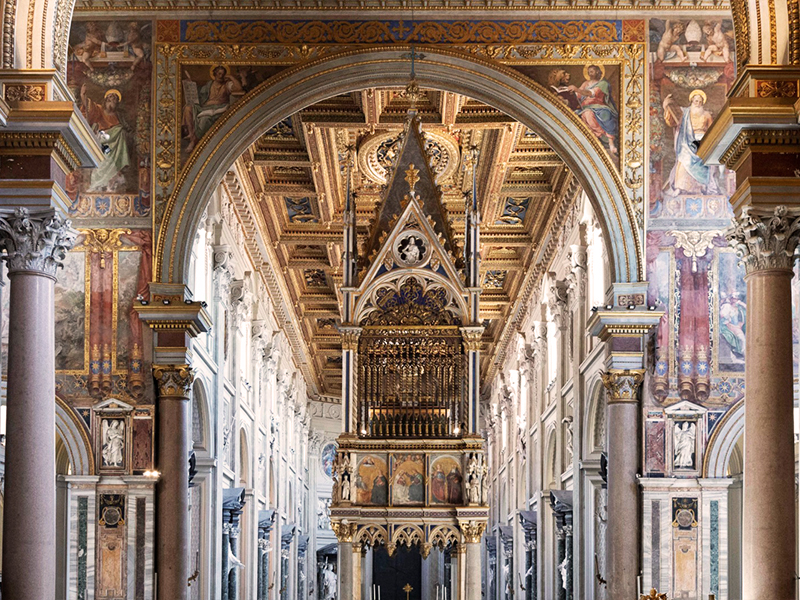
Interior detail of the Basilica of St. John Lateran, Rome
Where spirituality and art meet along one of the Eternal City’s oldest pilgrimage routes
In Roman slang, “doing the Seven Churches tour” has come to mean aimlessly wandering through the city’s side streets and alleyways — a tongue-in-cheek nod to long, circuitous detours. Yet behind the irony lies a sacred tradition dating back to the Middle Ages, later formalised in the 16th century by Saint Philip Neri, the so-called “saint of joy.”
He conceived this urban pilgrimage — an accessible alternative for those unable to reach Jerusalem or Santiago — as a way to encourage penance and offer the faithful the opportunity to gain indulgences. Thus was born the Way of the Seven Churches: a spiritual journey that is also a voyage through art and architecture, symbolising Christ’s path from his arrest to his death and resurrection.
Now, in celebration of the Holy Year 2025, the route has been officially recognised as part of Rome’s Jubilee Walks: seven stages, 25 kilometres, and a narrative that spans the centuries. A special edition of the pilgrimage, held overnight from 16 to 17 May 2025, saw pilgrims depart from Chiesa Nuova — where Saint Philip is buried — walking together in prayer, song, and silent contemplation under the Roman night sky.
Although the official event has ended, the Seven Churches Walk remains a timeless invitation to rediscover Rome from a deeper perspective — where art and faith, stone and light, spirituality and beauty converge in a harmonious journey through early Christian mosaics, Renaissance masterpieces, and Baroque splendour, all housed within the city’s most iconic basilicas.
The Seven Churches
1. St. Peter’s Basilica (in Vatican City)
In Rome, every basilica is a world unto itself — not only places of prayer and contemplation, but also of artistic marvel and historical discovery. The beating heart of Catholicism and the largest Christian basilica in the world, St. Peter’s is one of the city’s most powerful symbols.
Here, Italian art reaches one of its highest expressions: Michelangelo’s Pietà — sculpted when the artist was just twenty-four — and Bernini’s monumental bronze Baldacchino, a towering canopy whose twisting columns seem to reach toward the majestic dome above. That dome — known to Romans simply as il Cupolone — was designed by Michelangelo himself and offers one of the most breathtaking views over the Eternal City. Beneath the papal altar, in the Vatican Grottoes, lies the tomb of the Apostle Peter, the first Bishop of Rome.
2. St. Paul Outside the Walls
Rebuilt in the 19th century after a devastating fire, the Basilica of Saint Paul Outside the Walls, located along the Via Ostiense, radiates a sense of grandeur and solemnity that is nothing short of awe-inspiring. Beneath the high altar rests the tomb of the Apostle Paul, one of Christianity’s founding figures, who, according to tradition, was martyred near this very spot.
The vast central nave, lined with majestic columns, is adorned with a remarkable series of medallions portraying every pope in history, from Saint Peter to Pope Francis. According to the legend of Saint Malachy, the completion of these medallions will herald the end of the papacy, the Church — and even Rome itself. Thankfully, it remains only a legend.
3. St. Sebastian Outside the Walls
Among the cypresses and pine trees of the Appian Way, in a landscape seemingly frozen in time, stands the Basilica of Saint Sebastian Outside the Walls — the most intimate of the seven. Built atop an intricate network of early Christian catacombs, it was among the first places to shelter the remains of the Church’s martyrs. As you walk through its underground corridors, you enter a world of sacred silence, broken only by the presence of ancient inscriptions, graffiti, and votive niches that recount the earliest centuries of Christianity.
The echo of medieval processions still lingers around the saint’s relics, preserved in a sarcophagus beneath the chapel. With its blend of Romanesque and Baroque elements, the basilica remains a deeply spiritual and contemplative space, its mystical atmosphere enhanced by the soft light that filters through its narrow windows.
4. St. John Lateran
Omnium urbis et orbis ecclesiarum mater et caput. The inscription on the façade speaks for itself: the Archbasilica of St. John Lateran is the cathedral of Rome and the oldest church in Europe. Its solemn architecture, partly shaped by Borromini’s 17th-century restorations, has conveyed spiritual authority for centuries — through colossal columns, a richly adorned apse, and a magnificent Gothic ciborium commissioned in 1368 by Pope Urban V. Inside, a fresco attributed to Giotto adds to the artistic wealth, while the bronze door — originally from the Roman Forum’s Curia — symbolically links Imperial and Christian Rome.
Beside the basilica stands the Lateran Palace, historic residence of the popes until the Avignon exile, along with the medieval Cosmatesque cloister, famed for its polychrome mosaics and intricate geometries. The final stop is the Holy Staircase, which — according to tradition — Jesus climbed in Pilate’s praetorium and which pilgrims still ascend on their knees, in silence and devotion.
5. Holy Cross in Jerusalem
More secluded than the four major basilicas, the Basilica of the Holy Cross in Jerusalem was commissioned by Saint Helena, mother of Emperor Constantine, on the site of the imperial Sessorian Palace. Her intent was to enshrine relics of Christ’s Passion brought back from the Holy Land: two thorns from the crown, a nail, and a fragment of the Titulus Crucis — the trilingual inscription once affixed to the cross. The floor of the original chapel was strewn with soil from Jerusalem itself, giving the basilica its name. Simple in form yet deeply imbued with spiritual resonance, it remains one of the most evocative places of worship in the city.
6. Saint Lawrence Outside the Walls
A site of martyrdom and memory at the threshold of the Verano — Italy’s largest monumental cemetery — the Basilica of Saint Lawrence Outside the Walls preserves the tomb of the young deacon Lawrence, who was burned alive on a gridiron for refusing to deny his faith. His martyrdom made him one of the most revered saints in Christianity.
Architecturally, the basilica is a remarkable mosaic of periods and styles: an early Christian plan, a medieval nave, Baroque additions, and a persistent Romanesque spirit. Also interred here is Alcide De Gasperi, statesman and founding father of the Italian Republic — a presence that underscores the enduring bond between sacred tradition and civil memory in Rome’s cultural fabric.
7. Saint Mary Major
The final stop — and perhaps the summit of Roman sacred art — the Basilica of Saint Mary Major is the foremost Marian church in the world. Here, every surface tells a story: 5th-century mosaics depict scenes from both the Old and New Testaments, while the coffered ceiling — said to be gilded with the first gold brought from the Americas — reflects the Church’s spiritual and temporal grandeur.
Two monumental chapels enhance the basilica’s splendor: the Sistine Chapel (not to be confused with the one in the Vatican), also known as the “Chapel of the Crib,” and the Pauline Chapel, at whose base lies Gian Lorenzo Bernini, the unrivaled genius of the Baroque. Since 2025, Pope Francis has chosen this basilica as his final resting place, breaking with the centuries-old tradition of papal burials in the Vatican Grottoes.
Hotel TriviHo: Signature Hospitality in the Heart of Rome
An eclectic boutique stay to experience the Eternal City in style
Just steps from the Trevi Fountain and the Spanish Steps, TriviHo – Luxury Hotel Rome, located at Via Barberini 50, offers a curated hospitality experience where every detail is crafted with care.
Housed in a rationalist-style building designed in the 1930s by architect Marcello Piacentini, TriviHo blends contemporary art, bespoke furnishings, and finely tuned lighting. Not only the guest rooms but also the common areas — complete with cozy seating and art books to browse — create an atmosphere that invites rest, reflection, and quiet inspiration.
The hotel’s crown jewel is THRoof, the panoramic terrace on the seventh floor, offering a breathtaking 360-degree view of Rome’s rooftops. It’s the ideal setting for a light lunch or a sunset aperitif, as the city blushes pink and the skyline transforms into a spectacle of light, history, and charm.
The Seven Churches Walk — Starting from TriviHo
A slow-paced journey through art, faith, and Roman elegance
For TriviHo guests, the Seven Churches tour becomes an accessible and customisable route — perfect for a Roman weekend immersed in beauty, culture, and meaning.
Lifestyle tip: divide the walk into two leisurely days to savour the experience at its fullest. Between stops, indulge in the flavours of traditional Roman osterias or enjoy a refreshing gelato as you wander through the narrow, storied alleys of the historic centre.
Day 1
1. The Basilica of Saint Mary Major – Just a 15-minute walk from TriviHo.
2. St. John Lateran Archbasilica – Reachable via Metro A (from Vittorio Emanuele to San Giovanni) or Bus 16 (towards Costamagna).
3. The Basilica of the Holy Cross in Jerusalem – A 10-minute walk from Piazza San Giovanni.
4. The Basilica of Saint Lawrence Outside the Walls – About 10 minutes by taxi or via Tram 3 (direction Valle Giulia).
Day 2
5. The Basilica of San Sebastiano Outside the Walls – 20 minutes by taxi, or take an electric bike along the Appian Way for a more immersive experience.
6. The Basilica of Saint Paul Outside the Walls – Roughly 15 minutes by taxi.
7. St. Peter’s Basilica in the Vatican – Around 20 minutes by taxi, or Bus 23 (towards Clodio).
Whether you’re an art enthusiast, a spiritual seeker, or simply a curious traveler, the Seven Churches Walk offers a unique lens through which to discover Rome — where every step echoes centuries of devotion, beauty, and timeless wonder.